Why is thar desert important to India?: for eco balance
Thar desert is one of the most important parts of Rajasthan for desert tourism in India and offers a beautiful camel and keep safari along with camp staying for the tourists.
Thar desert has its indispensable importance in India due to the mining of two main valuable reserves such as phosphorite, and feldspar which play an important role in the development of the country.
These minerals are necessary for producing the most valuable products, fertiliser and cement, which are the backbone for the development of any country. Therefore, the importance of the Thar desert can not be ignored.
why is the thar desert important to India? and Pakistan

The Thar Desert also acknowledged as the Great Indian Desert is the most famous India and is spread over an area of about 2,00,000 km. and is the 9th hot desert with the rank of 20th largest desert in the world.
It touches the boundaries in Rajasthan of India and Punjab and Sindh in Pakistan.
It is so dangerous that one can unknowingly cross the borderline of the enemy country they will be in great trouble.
This place is full of dunes and hot winds which is no doubt a life threat for anyone. Therefore, this is included in the list of the top most dangerous places in India.
The existence of about 22 species of poisoner snakes like Sand Boa, Rat Snake, Black Cobra, Saw Scaled Viper and much more makes this place more dangerous because it is very unpredictable from where and when they appear and give a deadly bite.
There is no rain or a little therefore this place remains dry and hot all around the year. Despite all these dangers, this place is highly dense in the world with about 85 people in a square km. Therefore this is a part of the 10 Top Most Dangerous Places in India.
The other reason for its danger is that one can die of hypothermia at any time. One can not find water at this place easily because the quantity of water is very little and also not know where it is.
The quick change of temperature i.e. very hot in the daytime and cold at night makes anyone sick.
This place is just opposite Antarctica because this is full of deadly hot sand and Antarctica is full of deadly snow and cold. This is a part of the 10 Top Most Dangerous Places in India.
The inter-dune areas add more danger to this place because its grounds are covered with a thin dry crust and in case any vehicle crashes in the layer, it will submerge in the underground mud which will cause instant death.
Though this place is full of dangers but is a paradise for those tourists and visitors who like thrill, adventures, new cultures and traditions without giving a second thought to the pain and life.
After reaching the Thar desert one can enjoy the sunrise and sunset scenes, and caravans of camel including their grazing and travelling herds on different sizes of dunes.
The thorny bushes, folk music and dances, traditional dresses and jewellery of the woman give the most entire knowledge of lifestyle and culture of this place.
The tourists and visitors also gather memories of the egg-shaped hills of Karon-Jhar and the valley and the holy places of Hindus.
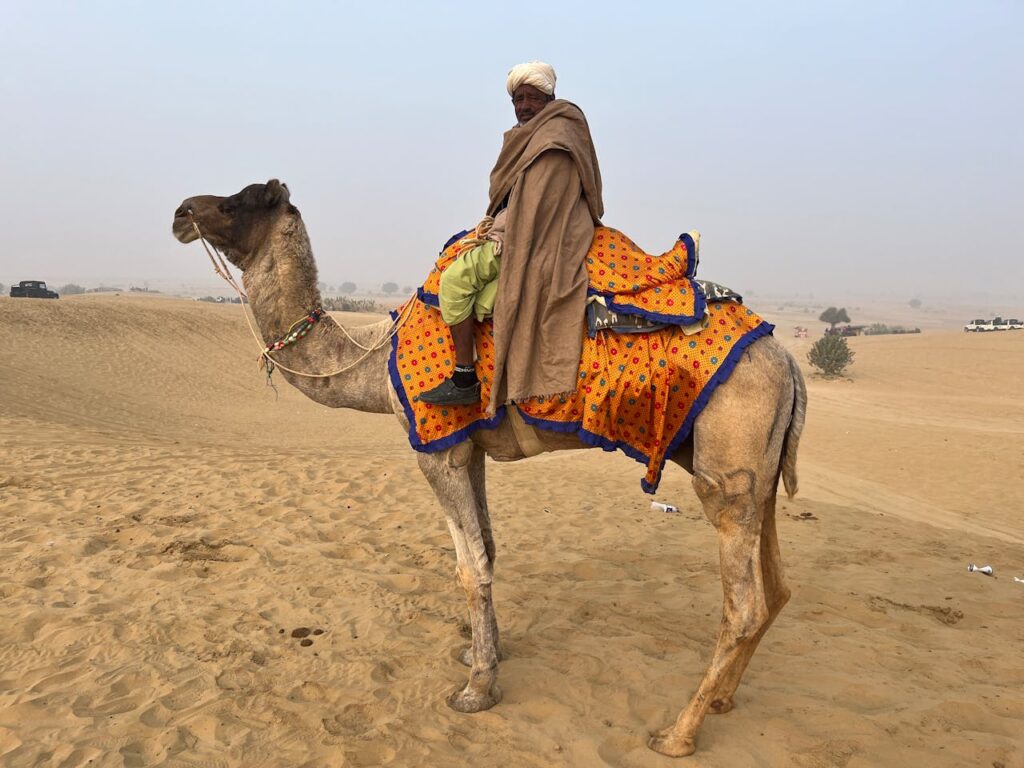
What is special about the Thar Desert?
The Thar desert has an attraction for tourists because a festival known as the desert festival is celebrated in this place every year in the winter season which is one of the pride of Rajasthan.
- This is the 9th biggest-hot tropical desert and it has the status of 17th largest desert in the world.
- Animal husbandry and agriculture are the main work of about 40 per cent of Rajasthan state who live in this desert.
- This is awarded by UNESCO as the best eco-system in the National Part and Lalsuharna Biosphere Reserve which lies on the Pakistans side of the Thar desert.
- The native species of this desert are about 26 species of snakes and 25 species of lizards.
- The Thar desert is the paradise of about 142 species of indigenous and migrated birds.
The main variety of fauna and flora in this desert are:
Best time to visit the Thar Desert:
FAQ on Thar Desert
1. What is the Thar Desert?
The Thar Desert, also known as the Great Indian Desert, is one of the largest deserts in Asia. It is a vast arid region located in the northwestern part of India.
2. Where is the Thar Desert located?
The Thar Desert lies mainly in Rajasthan, and extends into Punjab, Haryana, Gujarat, and parts of Pakistan.
3. Why is it called a desert?
It is called a desert due to:
- Extremely low rainfall
- High temperatures
- Lack of vegetation
- Sandy and rocky terrain
4. What is the climate like in the Thar Desert?
- Summers are extremely hot (rising above 45°C).
- Winters are cold at night.
- Rainfall is very low and mostly during monsoon.
5. Which animals are found in the Thar Desert?
Some common desert animals include:
- Camels
- Desert fox
- Chinkara (Indian gazelle)
- Monitor lizard
- Peacocks
Camels are known as the “ship of the desert.”
6. Which plants grow in the Thar Desert?
These include drought-resistant plants such as:
- Cactus
- Babool
- Khejri trees
- Date palms
- Scrub grasses
7. Why is tourism popular in the Thar Desert?
Tourists visit for:
- Camel safari
- Sand dune rides
- Desert camping
- Cultural festivals
- Folk music and dance
Places like Jaisalmer, Bikaner, and Jodhpur are famous tourist hubs.
8. What are sand dunes?
Sand dunes are large mounds of sand formed by strong winds. The Sam Sand Dunes near Jaisalmer are popular for desert activities.
9. Is farming possible in the Thar Desert?
Yes, due to irrigation projects like:
- Indira Gandhi Canal
It has made farming possible in many areas, especially wheat and cotton farming.
10. Which tribes and communities live in the Thar Desert?
Major groups include:
- Bishnoi
- Rajputs
- Jats
- Banjaras
They are known for unique traditions, clothing, and arts.
11. What is the Desert Festival?
The Jaisalmer Desert Festival is an annual event featuring:
- Camel races and shows
- Rajasthani folk dances
- Turban tying competitions
- Cultural plays
It attracts visitors from around the world.
12. Are there wildlife sanctuaries in the Thar Desert?
Yes, the desert has protected areas like:
- Desert National Park
- Tal Chhapar Sanctuary
These areas preserve rare desert wildlife.
0 Comments