7 Best Ancient Places in India: For History Lovers

Overview
The ancient Indian civilisation centred around the Indus valley consists of the planned cities like Harappa and Mohanjo-Daro with an advanced sewage system, grid layouts and public baths. They were using standard tools, bricks and a system of measurement. The people of the Indus Valley traded with other ancient civilisations, which included Mesopotamia, and also had a shared script which remains undeciphered, therefore ancient places in India are favourite for history lovers.
The decline of the civilisation was around 2000 BCE due to the shift of the monsoon pattern, climate change or the arrival of new peoples. The ancient civilisations were divided into different ages, like the Vedic Age ( c. 1500 – 500 BCE ), the Arrival of Indo-Aryans, Religious Foundation and Rural Life. The Rise of Empires and Religions – Mauryan Empire, Buddhism and Jainism, and Gupta Empire.
The modern South Asian Culture foundation was laid down in the ancient period with the continuous influence of festivals, religions and philosophical ideas. The major contributions of ancient India were the introduction of negative numbers, zero and advanced algebra and trigonometry. Ancient India also introduced games such as Snakes and Ladders and Chess. Ancient India is the Indian subcontinent from the old prehistoric periods and started to Medieval India.
Ancient Places in India to Experience History
1. Hampi – Karnataka

Hampi is an ancient city in the Vijayawada district of Karnataka, India. This city is situated along the Tungabhadra River in the east and is near the city of Hospet. This city is known for hosting the Hampi Group of Monuments, including Virupaksha Temple, which is listed as a UNESCO World Heritage Site. Hampi, being an ancient city, was the glorious capital of the Vijayanagara Empire and was a thriving city from 1336 to 1565 AD.
Hampi is an ancient name, as the Pampa Devi Tirtha Kshetra was established here and is linked with the Ramayana period, where it was believed as the mythical monkey kingdom of Kishkindha. It is also believed that distinctive boulders are remnants of the epic battle fought at this place. Hampi became the capital of Vijayanagara in 1336, which was founded by the Sangama brothers. In ancient times, Hampi was the richest and largest city in the world. So it is definitely an amazing ancient city.
If you still visit there, you can find the ancient symbols and shadows which will remind you of the ancient history of India. Hampi is still continues to be a religious centre with the active Adi Shankara-linked monastery and Virupaksha Temple and various other temples of ancient times. A large number of tourists visit Hampi from all over the world to see its ancient history and its evidence.
Places to Visit in Hampi
- Virupaksha Temple
- Shri Lakshmi Narasimha Temple
- Shree Vijaya Vitthala Temple
- Saasivekaalu Ganesha Hampi
- Grandeur of Hampi
- Matanga Hills Top
- Group of Monuments
- Lotus Mahal
- Hemakuta Hill Temple
- Shri Achyutaraya Swamy Temple
- Elephanta Stables
- Queen’s Bathhouse
When to Visit Hampi
The best time to visit Hampi is between October and March, when the weather is cool and pleasant, suitable for exploring historical ruins. The visitors can enjoy the Hampi Utsav Festival organised in November every year. From April to June, the weather remains hot and dry and humiliates most of the visitors. The monsoon season starts from July up to September, perfect for rain lovers to enjoy riverside ruins, rice paddies and rain-filled landscapes.
2. Madurai – Tamil Nadu

Madurai is an ancient city in Tamil Nadu, India and has been inhabited since the 3rd century BCE by Megasthenes, a Greek traveller who probably visited at that time. This city has a documented history of about 2,500 years. It flourished as a major centre under the kingdom of the king Pandya during the Sangama period.
As the City that Never Sleeps and Athens of the East, its history is linked with Meenakshi Amman Temple, which was founded on the ancient site around the foundation of Pandya rule, Kulasekhara. The ancient Madurai city established trade with Greek and Roman visitors about the 3rd century BCE, which shows the prominence of Madurai’s ancient trade network.
According to the extensive literature and historical details, the Sangam period lasted for about eight centuries. The city has a rich ancient historical background, as the Lord God Shiva himself performed sixty-four wonders known as “Thiruvilaiyadals”. This, Mushari, is one of the ancient cities in India. The Archaeological Survey of India and historians established this city as an ancient city through their various research and evidence. If you are anxious to know the ancient history of India, you must visit Mundari.
Places to Visit in Mushari
- Meenakshi Amman Temple
- Ghandhi Memorial Museum
- Arulmigu Koodal Azhagar Temple
- Thirumalai Nayakkar Palace
- Vandiyur Mariamman Teppakulam
- Samanar Hall
- Puthu Mandapam
- Jain Rock Cut Temple
- Azhagar Kovil
When to Visit Madhuri
The best time to visit Madhri is between October to March because the weather in this time remains pleasant, cool and less humid and therefore is supposed to be the best season for tourism. This time is the best for indoor as well as outdoor activities, especially for tourists who want to witness the ancient monuments and other symbols. July to September is the rainy season, which brings rain and humidity.
3. Varanasi – Uttar Pradesh

Varanasi, also known as Kashi, is believed to be one of the oldest inhabited cities in the world. The old name of Varanasi is Kashi, which means the city of light. It was one of the 16 ancient Indo-Aryan political units. The mythical origins of Varanasi extend thousands of years ago evidenced by ancient Maharashtra, Vadas and Puran. Archaeologists found that it dates back to the ancient epics from the 9th century BCE.
During the Maurya Empire, it was a significant political and cultural centre. The great Morya emperor Ashoka’s edicts and pillars are still present. About 2,500 years ago, at the time of Buddha, it became a major learning centre, although Buddha himself stayed near Sarnath. After 1090BC, Varanasi became the capital of the Gahala Dynasty and transformed it into a major centre of Brahmanical temples and pilgrimage for Buddhists. In 1194, Muhammad Gauri defeated the Gahala King, which led the city to be asked.
Then Varanasi was controlled by the Delhi Sultanate and the Mughals. Now, Varanasi has its religious significance and it is believed that whoever sacrifices their life in this holy city is relieved from the cycle of life and death and gets Moksha. Therefore, a large number of tourists visit Varanasi every day to watch Hinduism and its style of worship.
Places to Visit in Varanasi
- Ganga River (Ganga)
- Ganga Aarti
- Kashi Vishwanath Temple
- Assi Ghat
- Manikaran Ghat
- Sarnath
- Deshashwamedh Ghat
- Alamgir Masjid
- Ramnagar Fort
- Tulsi Manas Temple
- Vindham Waterfalls
- Nepali Museum
- Gyan Vapi Well
When to Visit Varanasi
The best time to visit Varanasi is from October to March, when the temperature is pleasant and cool. It is a perfect time for outdoor activities like visiting various ghats and temples and observing river rituals therefrom. This is also the best time to attend various festivals organised in Varanasi, like Diwali and Dev Deepavali, which create a magical atmosphere in the city.
4. Khajuraho Temple

Situated in the Chhatarpur district of Madhya Pradesh, India, Khajuraho is a group of Monuments of Digambar Jain temples and Hindu temples. Its distance is about 46 km from the Chatarpur district. Its ancient history revolves around its construction by the Chandela Dynasty, which was a period of great artistic and cultural achievement.
The Hindu and Jain temples, which were included in a UNESCO World Heritage Site, were known for their intricate sculpture depicting a large range of life themes and for Nagara-style architecture. It shows the music and gods to passion and desire. Out of 85 original temples ls only 25 temples remain today, which were the testament of the spiritual, rich and artistic legacy of the Chandellas. The ancient Khajuraho Temples were built by the Chandela king during the period they ruled in the region.
The construction of the most significant temples was done between 950 and 1050 CE. They are known for their elaborate and detailed sculptures created on exterior and interior walls. These featured temples were dedicated to the Hindu deities, including Vishnu, Shiva and Ganesh, and the temples for Jain tirthankaras. The caves were not only meant for religious purposes but also depicted a sense of daily life, dance, music, erotic themes and welfare, celebrating an ancient view of life.
Places to Visit in Khajuraho
- Kandariya Mahadeva Temple
- Lakshmana Temple
- Chaturbhuj Temple
- Khajuraho Temple Group
- Sri Aadinath Digambar Jain Mandir
- Javari Temple Khajuraho
- Varsha Temple
- Mahabaleshwar Temple
- Architectural Museum Khajuraho
- Vishwanath Temple
- Chitragupta Temple
- Panna National Park
- Kalinjar Fort
- Devi Jagdamba Temple
- Raneh Water Falls
When to Visit Khajuraho
Winter is the best time to visit Khajuraho between October and March, when the weather is cool and pleasant, suitable for sightseeing and outdoor activities. This is a UNESCO World Heritage site; therefore, a large number of tourists visit here from all over the world, so a cool climate is necessary to maintain a good temperature. This time is also perfect for attending the famous Khajuraho Sound and Light Show and Dance.
5. Bodh Gaya – Bihar

Bodh Gaya is an ancient place in Bihar, India and has its historical significance because Princ Sidhartha got enlightenment under the Bodhi tree and know as Buddha At the place where Mahatma Buddh meditated known as the magnificent Mahabodhi Temple Complex and listed in the UNESCO World Heritage Site which consists of a sacred point relating to the enlightenment of Buddha and an ancient pipal tree descended from the original Bodhi tree.
The first Mahabodhi Shrine was created by the king Ashoka in the 3rd century BCE. Since then, the temple has undergone various restorations, including the major work in the 19th century. Bodh Gaya is known as the birthplace of Buddhism, a pilgrimage site having millions of followers worldwide. The Bodhi tree is a religious symbol of Buddhism, which inspires people to follow the steps of Buddha to achieve enlightenment.
Bodh Gaya is therefore known as an ancient sacred place for Buddhism, where not only the followers of the Bodhisattva religion visit, but a large number of tourists visit from different parts of the world to understand the philosophy of Gautam Buddha and follow his steps.
Places to Visit in and near Bodh Gaya
- Mahabodhi Temple Complex
- Muchalinda Lake
- Great Buddha Statue
- Royal Buddha Monasteries
- Tergar Monastery
- Metta Buddharam Temple
- Karma Temple
- Vishnupad Temple
- Akshaya Vat
- Dungeshwari Cave Temple
- Barabar Caves
- River Falgu
When to Visit Bodh Gaya
The best time to visit Bodh Gaya is between October to March (in Winter) when the temperature ranges from 5 to 30 °C and the weather is pleasant and cool, making it the perfect time for outdoor pilgrimage and sightseeing. The weather in Summer from March to Jun,e is very hot and uncomfortable for most of the visitors and should be avoided.
6. Elephanta caves – Maharashtra

The Elephanta Caves are located on the office coast of Mumbai, Maharashtra, India. It has its ancient status due to dating back from the mid-5th to 8th centuries AD and is dedicated to God Shiva and Hinduism. Its original name was Gharapuri, and on this island, the presence of Buddhism appears as it shows its signs as early as the 2nd century BC. The creation of caves is attributed to the Rashtrakuta and Kalachuri dynasties.
The rulers Rashtrakuta, like the Chalukyas and the island, were controlled by the Portuguese before it passed to the British. Signs of a Buddhist Stupa on the eastern hill show a significance and early occupation of Buddhist pressure and a syncretism of cultures on the island. The main rock-cut sites were established between of 5th to 6th centuries AD and mainly dedicated to Lord Shiva. The main features of the caves are iconic sculptures, which are most notably the Trimurti showing the three-headed image of Lord Shiva and symbolising his creative, destructive and protective aspects.
This island was given a new name as Elephanta, by the Portuguese because of a colossal stone elephant was stood near the landing area. Later, when the Gharapuri island came under the control of the Portuguese in 1864, they started destroying the Elephanta Caves. Therefore, the Elephanta Caves have existed for an ancient time, and a large number of tourists visit this place every year.
Places to Visit near Elephanta Caves
- MTDC Restaurant
- Canon Point
- Gateway of India
- Chatrapati Shivaji Maharaj Terminus
- Chhatrapati Shivaji Maharaj Vastu Sangrahalya
- Juhu Beach
- Marine Drive
- Girgaum Chowpatty Beach
- Malgund
- Visapur Fort
- Korigad Fort
- Tungarli Lake
- Akshi Beach
When to Visit Elephanta Caves
From November to February is the best time to visit Elephanta Caves because it is the winter season and the weather remains pleasant and cool, perfect for visiting Elephanta Caves and other outdoor sightseeing. The Rainy season from June to September should be avoided because of heavy rain, and ferry services are disrupted and become slippery and unsafe. The morning is the best time to avoid the crowds and explore the caves comfortably.
7. Ajanta and Ellora Caves – Maharashtra

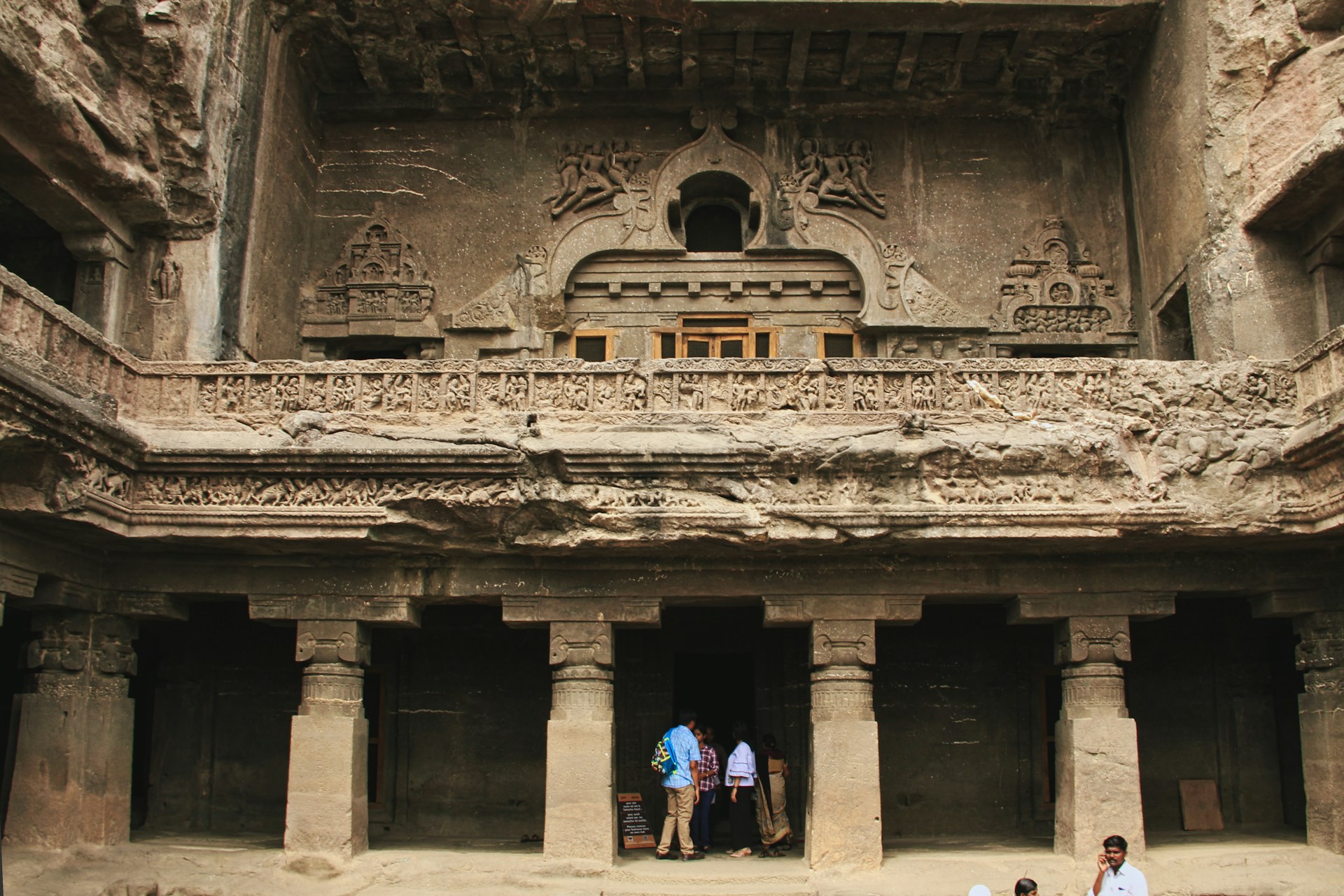
Ajanta and Ellora Caves have their own separate ancient history. Ajanta caves originated in the 2nd century BCE and evolved by the 5th century CE as a complex for Buddhist monastics known for its murals, whereas Ellora was caves from the 6th to 10th centuries CE and featured with mix of Hindu, Jain and Buddhist temples. The construction of both sites (Ajanta and Ellora) was patronage-driven, with various dynasties like the Vakatakas, Satavahanas, who supported the work at Ajanta and the Rashtrakutas at Ellora.
The Ajanta caves evolved into 29 rock-cut complexes serving as prayer halls for Buddhist Monks and monasteries. The caves were at their peak in the 5th century CE during the Vakatakas period, when artists created beautiful frescoes and sculptures narrating the teachings of Buddha and his life and the tales of the previous lives of Buddha.
Therefore, the Ajanta Caves are older than the Ellora Caves. Though most people think that they are the same because everyone knows them as the Ajanta and Ellora Caves. The ancient name of Ellora is Verul or Elura, which has faded with the passing of time. The Muslim Ruler, Aurangzeb, ordered to destroy Ellora Caves and Kailash Temple in 1682, but couldn’t succeed.
Places to Visit in and near Ajanta and Ellora Caves
- Buddhist Caves
- Kalasa Temple
- Hindu Caves
- Jain Caves
- Bibi Ka Maqbara
- Daulatabad Fort
- Grishneshwar Jyotirlinga Temple
- Ajanta Caves
- Ajanta Ellora Festival
When to Visit Ajanta Ellora Caves
October to March is the best time to visit Ajanta and Ellora Caves because of the Winter season, when the weather is pleasant and cool, and perfect for exploring cave sites and nearby places. June to September is the Monsoon season and should be avoided because of the slippery paths and heavy rain. April to May is the Summer season, and not recommended to visit because the weather is hot and humid. It will be difficult and uncomfortable for the visitors to explore the caves.
Conclusion
The ancient Indian civilisation centred around the Indus valley consists of the planned cities like Harappa and Mohanjo-Daro with an advanced sewage system, grid layouts and public baths. They were using standard tools, bricks and a system of measurement. The people of the Indus Valley traded with other ancient civilisations, which included Mesopotamia, and also had a shared script which remains undeciphered.
The modern South Asian Culture foundation was laid down in the ancient period with the continuous influence of festivals, religions and philosophical ideas. The major contributions of ancient India were the introduction of negative numbers, zero and advanced algebra and trigonometry. Ancient India also introduced games such as Snakes and Ladders and Chess. Ancient India is the Indian subcontinent from the old prehistoric periods and started to Medieval India.
0 Comments